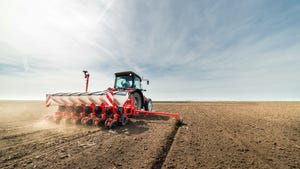
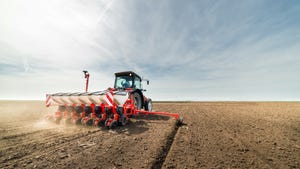
Herbicide-resistant marestail and waterhemp have caused Illinois grower Trent Funk to work the ground during his three-year rotation of soybeans, corn and wheat. Historically, weed control was a key reason for tillage, but that justification hasn’t existed for quite a while due to herbicide effectiveness, says University of Illinois professor of crop sciences Emerson Nafziger. However, it’s coming back, at least in some areas.
Funk explains his tillage rationale: “Soil conservation is definitely a good practice, and we no-till most of our soybeans, but you have to play the hand you’re dealt. And right now the best option for weed control and improved yields on our land is tillage,” he says. “I believe I’m giving up yield potential if I no-till corn, but I haven’t seen yield drag on our no-till beans.”
Funk, who farms with his father, brother-in-law and two sons, is also trying more vertical tillage with success.
Vertical-tillage tools lightly till the soil and chop crop residue with shallow soil penetration, leaving greater than 30% of residue on the soil surface. It has the advantage of leaving more residue cover than a field cultivator or a disk, but less residue than no-tilling.
“With vertical tillage we’re only disturbing the top 2 in. of soil,” Funk says. “We’re trying to limit soil damage but still break up compaction and get good seed placement.”
If you would have asked Nafziger about the future of no-till when he started working in Illinois in the early 1980s, his answer might surprise you now.
“The world was going no-till,” he says. “I thought at some point farmers would only need a tractor, planter and combine, and the tractor would only have to be big enough to pull the planter.”
But tractors keep getting bigger, compaction continues to be a problem, Mother Nature is still infuriatingly inconsistent...and tillage remains common. There was more tillage in Illinois last fall than Nafziger’s seen in a long time, in part because there was little chance to till in the wet fall of 2009.
“I call it compaction relief,” he says. “When it dried out after harvest, farmers needed to get into fields with a ripper and reintroduce the air that was squashed out when they drove heavy equipment over the fields.”
Compaction relief is one of the two reasons Nafziger believes we do tillage at all – to improve the root zone so the roots reach deeper to extract water and nutrients. The second reason is to improve seedbed conditions and seed-to-soil contact.
According to Nafziger, although large tractors and tillage equipment are found on most Illinois farms, it’s still common to hear claims that reduced or conservation tillage is on the increase and conventional tillage is on the decline. But he says deep, primary tillage in the fall has shown little decline.
“In fact, tractor horsepower continues to increase, as does the depth of primary tillage,” he says. Disk rippers and other modern configurations of heavy, soil-engaging implements can be considered the ‘new’ conventional tillage.”
No-till remains popular, especially for soybeans, due to its conservation benefits. In addition to reducing soil erosion, it helps increase water infiltration and limit runoff, and the remaining residues conserve moisture by reducing evaporation. Not turning over the soil also promotes plant and wildlife diversity and increases soil carbon sequestration.
The soil is not the only thing that benefits from no-till. Farmers can see economic advantages in the form of less fuel, less labor and lower production costs, too.
Nafziger has studied the effects of various tillage practices on yield in Illinois including deep-ripping, strip-tillage, vertical tillage and tillage practices on continuous corn. His observations include:
“We should only till as much as we need to in order to get a good stand and try to help the root system,” cautions Nafziger. Keep in mind what you’re trying to accomplish. If you don’t need to do tillage, then don’t.”
Don Schriefer was a pioneer in innovative work with tillage systems and was considered one of America’s first “environmental agronomists.” He established six “tillage commandments” as a foundation to guide tillage decisions (published posthumously in Agriculture in Transition, Acres USA, 2000). They seem to still hold true today.