Tillage Cuts N Needs

Working the ground improves mineralization Tilling the soil costs more money than no-till. But recent research indicates that a little tillage increases nitrogen efficiency at lower N rates. With soaring N prices, that could be important this spring.

This research also is important because some environmental groups, concerned about water quality, are calling for reduced N use by farmers.

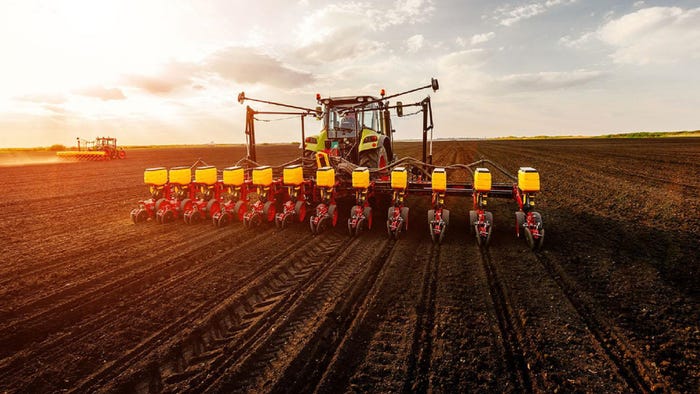
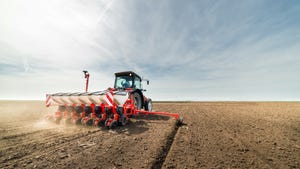
University of Illinois research assistant Jeff Wessel compared six N rates (0, 40, 80, 120, 160 and 200 lbs/acre) under three tillage systems. The systems were no-till, strip-till (10" bands tilled in the fall) and mulch-till (fall chiseling followed by one pass in the spring with a disk or field cultivator).

"There is evidence in the scientific literature that suggests tillage influences corn fertilizer N requirements," Wessel explains. "In fact, the extension services in Minnesota, Missouri and Kentucky advise corn growers to reduce fertilizer N usage when tillage is used, relative to zero-till. We wanted to determine the impact of different tillage systems on corn fertilizer N requirements under our conditions."

The testing, done over three years in eight environments, showed that at low N rates - 0-80 lbs/acre - yields increased significantly as tillage increased. For instance, with no nitrogen fertilizer applied, mulch-till yielded 132 bu/acre, strip-till went 124 bu/acre and no-till yielded 108 bu/acre.

At higher N rates - 120-200 lbs/acre - yields were statistically similar for all three systems. However, at the higher rates, no-till always posted the highest numerical yield. For example, at 160 lbs N/acre, yield was 204 bu/acre for no-till, 201 bu/acre for mulch-till and 200 bu/acre for strip-till (see table).

The optimum economic N rate for no-till was 200 lbs/acre, while 160 lbs/acre was the optimum rate for mulch-till and strip-till.

"Where nitrogen was not limiting yield, the zero-till outperformed the other two systems because of greater water availability," Wessel points out.

"The higher yields with mulch-till and strip-till at N rates of 0-80 lbs/acre are due to greater mineralization of soil N," he explains. "In unfertilized corn, mulch-till increases the soil N supply by 23 lbs/acre more than does zero-till. Strip-till increases soil N by 16 lbs/acre, compared to zero-till."

Why is mineralization greater as tillage increases?

The reduced surface residue on tilled ground means a higher soil temperature. That warmer, drier soil environment speeds microbial activity, which increases mineralization, Wessel explains.

Interestingly, his research shows that tilling one-third of the soil (strip-till) results in an increase in mineralization over no-till that's roughly two-thirds of the increase seen with full-width mulch tillage (16 vs. 23 lbs).

"This probably means a little tillage goes a long way in terms of N mineralization," Wessel says.

Discuss this Article 0

Post new comment
Sign In or register to use your Corn and Soybean Digest ID
(optional)

Newsletter Signup

Continuing Education Courses
New Course

Accredited for 2 hours/CCA Soil & Water credits. The 2,000 member...

This online CE course details sound mechanical irrigation design and management practices to...
Keeping crop protection chemicals on the crop for which they are intended has been a...
Connect With Us