Larry Stalcup

Articles by Larry Stalcup
Soybean Price Volatility Spills Over Into New Year

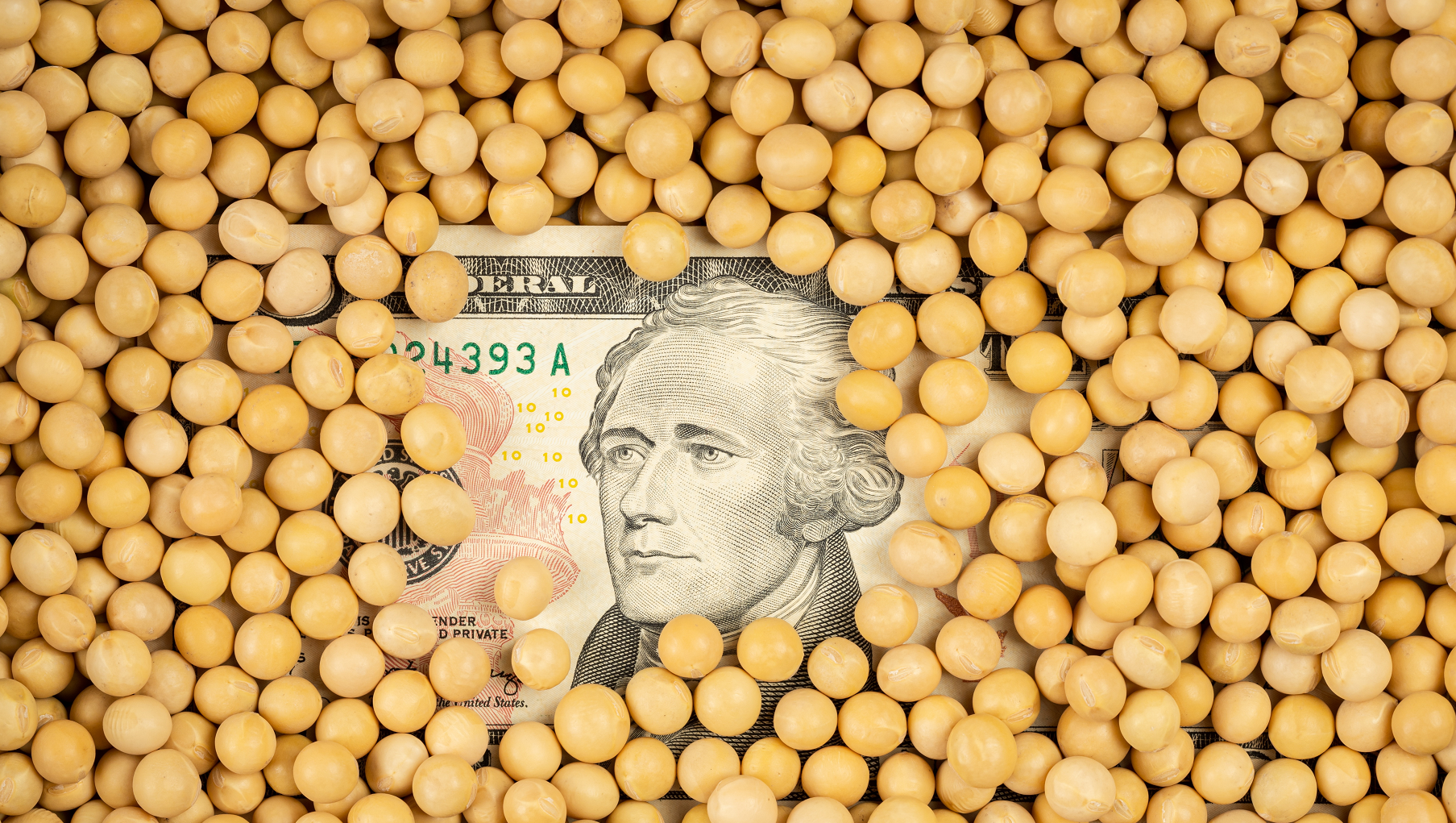
When the big ball dropped in Times Square to usher in 2013, it resembled the path of soybean and other grain prices that began the year tumbling down. Price volatility – up one week, then down the next – is the new normal. Looks like it’s here to stay. November 2013 soybean futures, which closed at $12.84/bu. Jan. 7, saw a $3/bu. swing from June to early September, a $150/acre swing in return for a 50-bu. crop. They jumped from $11.40 to near $14.40.

Chances for Insurable Margins Again for 2013

With the likelihood of lower premium rates and better overall coverage, federal revenue crop insurance should provide farmers with tools to potentially insure profit margins for 2013 crops, says Bruce Sherrick, a University of Illinois farmdoc farm management specialist. He stresses that with crop price protection levels likely in the $5.70/bu. range for corn and about $12.75/bu. for soybeans, “adequate margins may be insurable again this year.”

Seasonal Commodity Price Trends Apply

“Know them and respect them. But don't let seasonal trends be your only pricing guide.” That’s Ed Usset’s advice about historic corn and soybean price trends. Except for Corn Belt drought years like 1988, 1995 and 2012, you’re more likely to see higher prices for corn and beans in March through June than from July on, says the University of Minnesota Extension grain marketing specialist. Today’s price volatility, however, creates massive spikes in prices that can provide great marketing opportunities virtually year-round.

South Dakota farmer Dwayne Beck uses cover crops in his farming practice
Farm Outside the Box | Cover Crop Cocktails Pay Off in Western South Dakota Research

Dwayne Beck admits right away that his farm “is research.” Why else would he alternate alfalfa with continuous corn? Say what? That’s a sampling of the different farming approach he takes at the Dakota Lakes Research Farm, Pierre, S.D. The producer-owned farm, also part of South Dakota State University’s ag research program, is led by Beck’s no-till-or-nothing approach. He takes conservation farming to the next level.

Keep Price Ego in Check | Don't Get Greedy When Marketing Corn, Soybeans

It was mid-July and corn jumped $2/bu. over early June. That $7.40 would yield a sweet profit. But drought-driven $9 was “guaranteed” around the co-op coffee pot. Your co-op buddies just knew it. So did some pro analysts. When it pegged at $8.40+ about Aug. 10, you weren’t going to be the one who sold too soon. And in late September, when corn was back down to $7.40, you were still unsold. And you still weren't when it rebounded after the mid-October crop report and closed at $7.65 on Oct. 19.

Grain Marketing Grid | Pricing Decision Grid, Consultants Can Help You Pull the Trigger 1

Does marketing your corn or soybeans drive you nuts? Does pulling the trigger cause you to break out? Like it or not, marketing and prudent risk management is as important as making a good crop. For farmers with little marketing discipline, a decision grid can help solidify their risk-management program, says Carl German, University of Delaware Extension grain marketing specialist. He helped lead a USDA Northeast Center of Risk Management Education program to devise a marketing decision aid several years ago.

Manage Your Basis | Expand Your Horizons to Help Improve It

“What happened? Corn futures went up 25¢ so I sold a contract. But the basis dropped 20. That stinks. Am I getting the shaft?”

Match Input Purchases with Crop Sales | Cover All of Your Risks

“Don’t pull a VeraSun.” Illinois Extension Economist Scott Irwin’s warning is for growers who may teeter on economic catastrophe if they pay high prices for fertilizer or other inputs without matching them with corn or soybeans sales. His reference to the bankrupt biofuels company – which apparently failed to hedge against grain it purchased – illustrates the enormous financial risks farmers take.

Revenue Protection Payoff

A new Risk Management Agency (RMA) program could minimize the misery for Hoosier Brian Kemper and thousands of other growers who have suffered through the dire-straits drought that rivals the anguish of 1988.

Five-State Farmer Manages Margins | Watch Input, Output prices and Spread Risks Across Crops, Geography 1

When you farm 35,000 acres in five states, balancing input purchases with crop pricing can boost the bottom line. But a leading indicator to make one of those trades may not keep you from lagging on the other in the decision-making process. That’s Donny DeLine’s attitude. He doesn’t always market the same percentage of corn or soybeans to match production with inputs bought. But if both ends of the spectrum look good, he takes action. In fact, early fertilizer purchases and bulk buys last summer helped him save 20% or more over prices this spring. And by booking corn early, he had almost 50% of it priced at $6 or higher.

Manage Price Volatility | Options Strategies Can Help Tame Price Gyrations

Huge market rallies in late June saw December 2012 corn jump from $5.05/bu. to $6.44 within two weeks. They swelled 40¢ on June 25 – hello limit-up – on the back of Corn Belt drought fears. They blew through $6.20 on June 26 and $6.40 on the 27th. And by mid-July, the price-surging weather market shot Dec corn to $7.80.

Lock In Soybeans | $12 or $13 Soybean Prices are Tempting

Are the fundamentals surrounding soybeans causing prices to surpass expectations? At least one Corn Belt grain marketing specialist thinks so. And it could be a signal for you to sell more beans this spring. Price volatility can take the life out of a market in a flash.

Marketing 101: HTA is Not a Four-Letter Word

HTAs can be a marketing tool that offers the benefits of hedging without threat of a margin call. But many think first of the hedge-to-arrive fiascoes in the mid-1990s. They are among a range of forward contracts offered by grain elevators, ethanol plants and other grain buyers, says Melvin Brees, University of Missouri Food and Agricultural Policy Research Institute (FAPRI) economist.

Bring Out the Best in Continuous Corn | The Yield is in the Details

Expect to spend more time babysitting the crop, say agronomists and seasoned continuous corn farmers. Devote extra time to in-season N, disease and insect management advises John Kretzmeier, Fowler, IN. He was all continuous corn until the last two years, when drainage on his flat land became too problematic for all but about 20% of his ground.

Slow Nitrate Flow | Small Check Dams Cut Nitrate Loss in Half

By installing small check dams within drainage ditches beside fields, research shows that growers can stop close to 30-50% of the nitrate nitrogen (N) from flowing downstream, according to Mississippi State University (MSU) studies.

Newsletter Signup

Continuing Education Courses
New Course

Accredited for 2 hours/CCA Soil & Water credits. The 2,000 member...

This online CE course details sound mechanical irrigation design and management practices to...
Keeping crop protection chemicals on the crop for which they are intended has been a...
Connect With Us