Cutting Corners the Smart Way

Sep 1, 2009 12:00 PM, By Susan Winsor

Scoring the highest profit with the least risk guides Steve Schmit.

Schmidt farms 16 quarters with some help running two combines and cotton strippers. He's gotten out of livestock and now has just 200 sheep to maintain the pastures.

He believes in just-in-time fertilizing. “It all boils down to the most limiting factor,” he says. “Crop physiology dictates the stages at which yield is determined: ear size, vegetative vs. reproductive growth, kernel count, number of pods or seeds per pod in various crops.” That stage is when he sidedresses, assuming there's moisture expected in the next two to three weeks.

HIS HAND-HELD Greenseeker infrared and near-infrared sensor optimizes his N sidedress timing, saving him an estimated 20-30 lbs. N/acre in wheat by optimizing application timing. “Without an accurate yield estimate, it is easy to overfertilize,” he says. “Oklahoma State University has documented this savings.”

On his corn, he applies 120 lbs. preplant N/acre, and if conditions merit, he sidedresses another 60 lbs. On wheat, he applies 30-45 lbs./acre in the fall, with the rest in one or two shots after Jan. 1, depending upon tillering. Double-crop milo is sidedressed based upon fifth-leaf analysis.

“If I save 20 lbs. of N at $240/ton (UAN), that equals $8.57/acre on my wheat, the Greenseeker has paid for itself at 338 acres,” he says. He uses rates determined by maximum return to N principles plus 10%. “You can't cut corners on fertility.”

With 30 years of soil analysis data, he uses spreadsheets to budget and compare crops each winter. He uses local custom rates for field operation figures.

“The interesting thing about the adoption curve,” says Schmidt, “is that the technology we adopt will someday define the new breakeven production costs, and that's what the average farmer will be doing. So if you're not adopting new ideas and reducing costs, you're falling behind tomorrow's norm.”

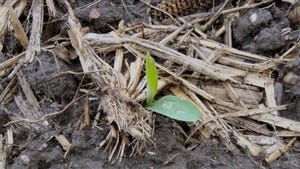
He adds, “A farmer's purpose is to harvest the sun and rain to produce food and fiber while maintaining or improving the soil, using specific inputs (primarily seed, fertilizer and livestock). “That is why I no-till. Through the Sumner County Residue Alliance (where he is president) and the Su Co conservation district, I try to help others achieve this goal.”

ECONOMICS OF EARLY ADOPTION

Kansas State University Extension Ag Economist Kevin Dhuyvetter explains why early adopters benefit the most from their innovation: “The producers with the lowest per-unit cost of production generally make the most money, and they bid up cash rents to get more land. Those not adopting a new technology find themselves falling behind because their costs lie above what cash rents support.”

Dhuyvetter points out that an example of this today is auto-steer. “Several years ago, no one used it, and tomorrow most everyone will use it. Once everyone uses it, it's no longer an advantage.

“When Western Kansas farmers adopted the rotation of wheat-milo-fallow, it provided an economic benefit relative to wheat-fallow. After this became the typical rotation in an area, the wheat-fallow growers found it hard to pay the going cash rents. They were using old technology that couldn't support higher rents caused by new technology.”

Get Copyright ClearanceWant to use this article? Click here for options!
© 2010 Penton Media, Inc.


Acceptable Use Policy blog comments powered by Disqus

Most Recent Story

View the Ed Usset Exam Archive *New

Weather

Continuing Education

Click here to view more courses


Accredited for 2 Units CCA Soil/Water Management:

(New Course)
Agronomic Principles and Efficient Chemigation and Fertigation Using Center Pivot/Linear Sprinkler Systems

This online CE course details sound mechanical irrigation design and management practices to allow efficient chemigation and fertigation.

Back to Top

Browse Back Issues

Related Sites