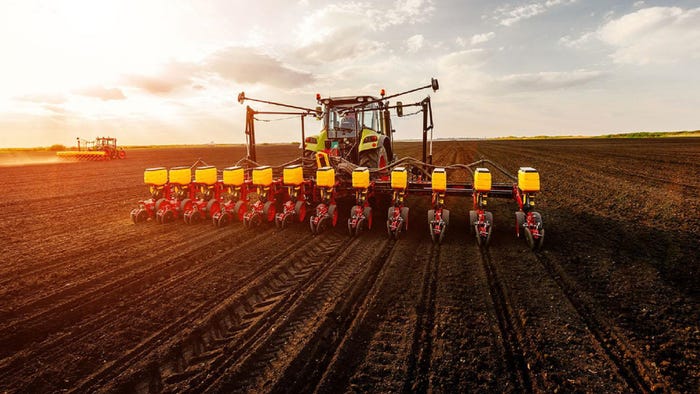
This winter I've had hundreds of questions on what kind of acreage shift is likely to develop as farmers shift to less soybeans and more acres of corn in 2005.
The supply-demand scenarios I have studied show that yield will be a more important price fundamental than shifting a million acres one way or the other.
For example, a 2-5 bu./acre change in the national yield changes the ending stocks number from surplus to shortage very quickly.
With all of the uncertainty, let's list some of the key fundamental facts that we know.
Acre shifts are usually less than expected, especially in the central Corn Belt where a lot of the input buying was already in place when the Asian soybean rust outbreak was announced.
The preliminary report from USDA on winter wheat acres shows 1.6 million fewer winter wheat acres. It is possible to have 1.6 million acres more corn and have soybean acres come in unchanged.
The Corn Belt is coming in with a full tank of water, so the most likely planting/crop production scare may begin with delayed planting.
The U.S. dollar has stabilized, but remains very low vs. the value just three to four years ago.
Global demand for soybeans continues to grow.
The most successful, profitable farmers are producers who maximize efficiency and yield. With all the uncertainty ahead, it makes more sense to stay with your normal rotation.
Maximize yield and, if you are really worried about soybean rust or aphids wrecking your crop in 2005, increase your crop insurance.
Stay with a disciplined marketing plan. Producers who sold into the crop scare rally in 2004 made a lot more money than those who waited and hoped. Odds are that producers who sell into the soybean rust scares in 2005 will do the same.
Alan Kluis is executive vice president of Northstar Commodity Investment Co. If you have marketing questions or want information, write: Northstar, 1000 Piper Jaffray Plaza, 444 Cedar St., St. Paul, MN 55101; call: 800-345-7692 or e-mail: aginvestor@agmotion.com.
| 2004-05 | 2005-06 | 2005-06 | 2005-06 | |
|---|---|---|---|---|
| NORMAL | LOW YIELD | HIGH YIELD | ||
| Planted Acres | 75.4 | 74.4 | 74.0 | 74.4 |
| Harvested Acres | 74.1 | 73.1 | 71.7 | 73.1 |
| Yield | 42.6 | 40.0 | 37.0 | 42.0 |
| Production | 3.141 | 2.924 | 2.650 | 3.070 |
| Begin Stocks | 110.0 | 440.0 | 440.0 | 440.0 |
| Total Supply | 3.269 | 3.389 | 3.090 | 3.535 |
| Crush | 1.660 | 1.660 | 1.640 | 1.680 |
| Seed & Res. | 0.154 | 0.150 | 0.140 | 0.155 |
| Exports | 1.010 | 1.040 | 1.010 | 1.040 |
| Total Use | 2.824 | 2.850 | 2.790 | 2.875 |
| End Stocks | 440.0 | 539.0 | 300.0 | 660.0 |
| Planted acres are in millions. Yield is in bu./acre. All other numbers are in billions of bushels. 2004-05 figures are from USDA, all others are Northstar Commodity projections. | ||||
| 2004-05 | 2005-06 | 2005-06 | 2005-06 | |
|---|---|---|---|---|
| NORMAL | LOW YIELD | HIGH YIELD | ||
| Planted Acres | 80.9 | 82.9 | 82.5 | 83.9 |
| Harvested Acres | 73.6 | 75.4 | 75.0 | 76.3 |
| Yield | 160.4 | 147.0 | 137.0 | 157.0 |
| Production | 11.807 | 11.080 | 10.270 | 11.980 |
| Begin Stocks | 958.0 | 2.010 | 2.010 | 2.010 |
| Total Supply | 12.780 | 13.090 | 12.280 | 13.990 |
| Feed & Ethanol | 8.870 | 9.045 | 9.000 | 9.100 |
| Exports | 1.900 | 1.950 | 1.900 | 2.000 |
| Total Use | 10.770 | 10.995 | 10.900 | 11.100 |
| End Stocks | 2.010 | 2.095 | 1.380 | 2.890 |
| Planted acres are in millions. Yield is in bu./acre. All other numbers are in billions of bushels. 2004-05 figures are from USDA, all others are Northstar Commodity projections. | ||||